

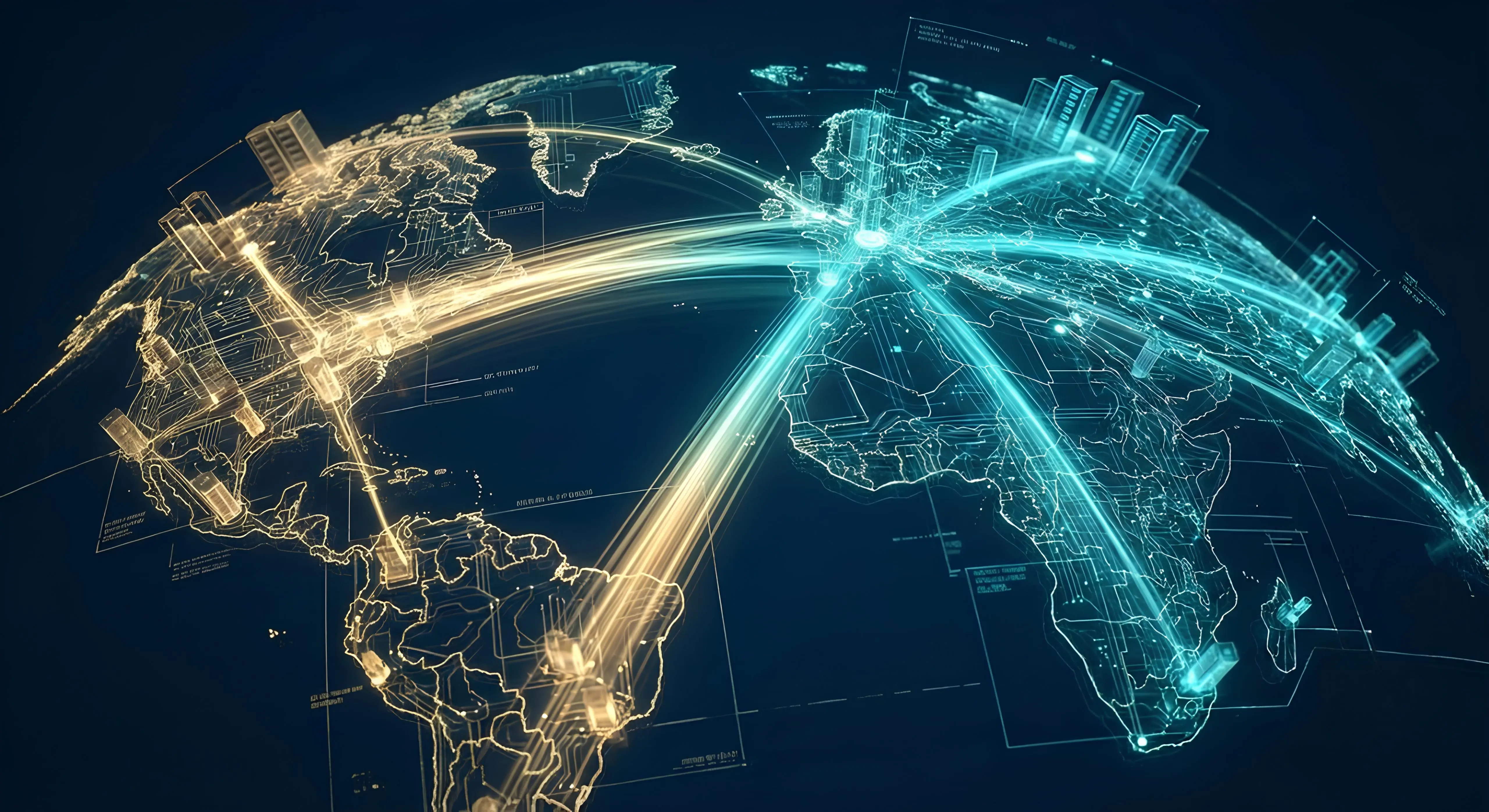
For the past few years, the artificial intelligence narrative has been dominated by software: which model has the most parameters, who tops the benchmarks, and whose chatbot generates the best code. However, as we advance through 2026, the paradigm has dramatically shifted. The primary bottleneck is no longer algorithmic innovation; it is physics.
The global race for AI supremacy is now being fought in the trenches of hard infrastructure: hyperscale data centers, high-capacity electrical grids, industrial cooling systems, and above all, silicon. In this new geopolitical chessboard, "AI Sovereignty" has evolved from a tech buzzword into a matter of national security. The consensus is clear: whoever controls the compute, controls the economic engine of the next decade.
Below, we break down how the world’s major players are injecting hundreds of billions into the physical foundation of AI, and what this means for the future of technology.
1. India: The Giant Awakens with a $200 Billion Bet
Historically positioned as the world's IT back-office, India has aggressively pivoted toward technological self-reliance and Sovereign AI. According to recent tech infrastructure roadmaps published by both the government and the private sector, the country has outlined projected investment commitments exceeding $200 billion for the coming years.
- Hardware Over Software: This projected capital injection is led by massive conglomerates. Companies like Reliance Industries and the Adani Group are not just investing in application layers; they are building the foundation. Their goal is to construct vast data centers powered by solar and wind energy, drastically reducing the cost of compute tokens for local developers.
- National Data Sovereignty: India learned a valuable lesson from its "India Stack" (the highly successful digital public infrastructure for payments and identity). They are now applying the exact same principle to AI: the data of 1.4 billion citizens must be processed, stored, and analyzed within the country's borders, utilizing models trained specifically on its immense linguistic and cultural diversity.
2. China: The Vertically Integrated Ecosystem
While the Western ecosystem is dominated by corporate giants with often diverging interests, China’s approach relies on state-coordinated vertical integration. Subjected to severe export restrictions on advanced microchips, China has been forced to reinvent its AI supply chain from the ground up.
- "Eastern Data, Western Computing": Facing spatial and energy constraints on the densely populated East Coast, the Chinese government is engineering mega-clusters for AI in its Western provinces, where renewable energy and land are abundant. It is an infrastructure megaproject on a continental scale.
- The Sovereign State Cloud: Necessity has accelerated domestic hardware innovation. Huawei’s Ascend accelerators and other local chips are now powering massive server farms designed specifically for government entities and state-owned enterprises, ensuring the nation does not rely on foreign technology to maintain its industrial machinery.
3. The United States: Private Capital Dominance and Concentration Risk
The United States remains the undisputed titan in terms of direct investment volume, surpassing $65 billion annually from venture capital and Big Tech R&D budgets. However, its structural model presents critical vulnerabilities.
- Compute Concentration Risk: Investment is highly monopolized. An oligopoly of hyperscalers (AWS, Google Cloud, Azure) absorbs almost the entirety of frontier hardware. When startups raise massive funding rounds, that capital inevitably flows right back to these same providers to pay for compute, creating a closed loop.
- Extreme Dependency and Geographic Bottlenecks: The American model suffers from a near-total dependence on NVIDIA's supply chain. Furthermore, physical infrastructure is dangerously centralized in specific geographic clusters—like "Data Center Alley" in Northern Virginia or the new mega-centers in Texas. This places unsustainable pressure on local power grids and has forced tech companies to fund Small Modular Reactors (SMRs) just to guarantee supply.
4. Saudi Arabia: Capital Injection for Strategic Positioning
Desperately seeking to diversify their economies ahead of the inevitable decline of fossil fuels, Middle Eastern powers are leveraging their massive sovereign wealth funds to buy their way into the AI race.
- A Projected $100 Billion Investment: Through initiatives like Project Transcendence, Saudi Arabia has launched a fund explicitly designed to transform the kingdom into the premier technological center outside of the US and China.
- AI Factories in the Desert: Through state-backed entities, they are erecting colossal data centers equipped with the latest generation of processors, focused on developing native Arabic Large Language Models (LLMs) to capture the market across North Africa and the Middle East.
5. Europe: A Regulatory Giant, an Infrastructure Dwarf
In this global map, the position of the European Union is paradoxical. While it unquestionably leads in the creation of legal frameworks (such as the AI Act), it suffers from a chronic deficit in hard infrastructure.
- Regulation vs. Compute: Europe remains regulatory-heavy but infrastructure-light. Lacking its own global-scale hyperscalers and frontier chip manufacturers, the continent risks becoming a mere consumer market—imposing rules on technologies that are physically trained and executed on American or Asian servers.
Summary of the Global AI Landscape (2026)
To understand how forces are shaping up in this new cold war of compute, here is a summary of the different global strategies:
| Region / Country | Dominant Strategy | Core Infrastructure Focus |
|---|---|---|
| United States | Private capital dominance | Concentration in the hyperscaler oligopoly (NVIDIA dependency risk). |
| China | State-coordinated vertical integration | Silicon self-sufficiency (Huawei) and western renewable mega-clusters. |
| India | Sovereign scaling with renewables | National public cloud, low-cost infrastructure, and data control. |
| Saudi Arabia | Strategic capital injection | Geopolitical positioning and AI factories for economic diversification. |
| Europe | Regulatory-first approach | Creation of legal frameworks (AI Act) with high reliance on external infrastructure. |
Conclusion: The Era of Sovereign Compute
When looking at these staggering figures—hundreds of billions of dollars, dedicated nuclear reactors, and continental-scale server clusters—it becomes evident that AI infrastructure is the new space race.
However, the underlying lesson applies at every scale of technology. Whether it is a nation investing $200 billion to avoid relying on foreign servers, or an independent project deciding to run private, open-source models on its own hardware, the philosophy remains the same: true technological independence requires owning your infrastructure.
As macroeconomic giants battle for control over global compute, the most critical question for any tech initiative today is no longer "Which AI model are you using?", but rather: "Where does your AI live, and who holds the keys?"